Impossible Geometry
Shapes that are not possible and create an optical illusion are often referred to as impossible objects. They consists of a 2D figure which is interpreted as 3D object and usually the impossibility becomes apparent after viewing the figure for a few seconds. Impossible objects are of interest to psychologist, mathematicians and artists and may have applications in computer vision and human cognition.
Circle Theorems
Circle theorems are a set of geometric rules that describe the relationships between angles, lines, and arcs within a circle. These theorems are used to solve problems involving angles and lengths in circles. Before you start learning about the theorems below, there are a few important terms that are commonly used in the geometry you shoudl revise first.
Once you've revised the basic circle-retaled terminology, you can explore all the Circle Theorems below. Simply click on the information icon for each of the theorem to learn more. Finally, you can also test your understanding by answering a short quiz question for each of the theorem. Have fun learning!
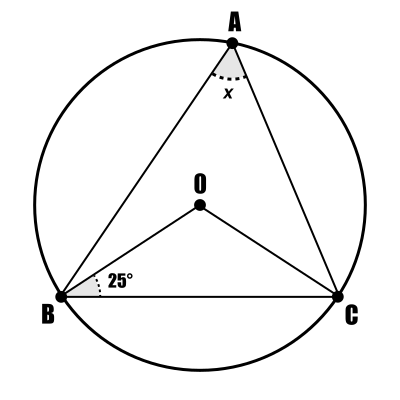
Angles at the centre
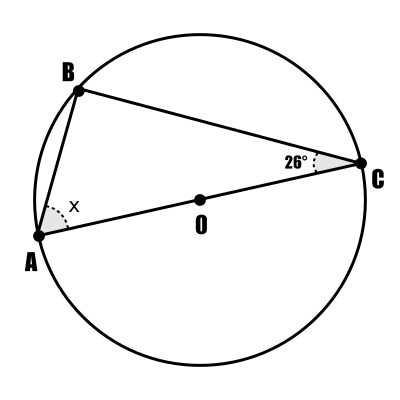
Angles in a semicircle
A circle has several key elements, each with a specific definition and role in describing and working with circles. Use the buttons below to toggle different circle elements and observe their position and relation to other elements.
The angle at the centre theorem states that the angle subtended by an arc at the center of a circle is twice the angle subtended by the same arc at any point on the circumference. In simpler terms, if you have an arc of a circle, the angle formed where the arc's endpoints meet at the center of the circle is double the angle formed when those same endpoints connect to a point on the circle's edge.
Adjust playback using controls
Look at the example below and calculate the value of angle x
An angle inscribed in a semicircle is always a right angle (90°). No matter where the point on the circumference is, the angle formed at that point (opposite the diameter) will always be 90°.
Adjust playback using controls
Look at the example below and calculate the value of angle x